
The French Revolution was a great political and social upheaval that started around the year 1789 and eventually changed the character of France and the world in a way that one could no longer remain indifferent. The revolution was over the ideals of liberty, equality, and fraternity, and thus became a pivotal point in world history, attracting nations to oppression and human rights.

The French Revolution era saw the reign of King Louis XVI, who ruled during the Ancient Regime, where the civilians were classified into three groups: those handling the Church matters, those dealing with the kings and nobility, and the rest. The Third Estate, which was made up of peasants, workers, and the bourgeoisie, was the one that suffered most as they paid the heaviest taxes and experienced poverty, high costs of bread, and lack of jobs. Moreover, the Enlightenment’s great thinkers, such as Rousseau, Montesquieu, and Voltaire, offered conceptions of political reform that were so rational, humane, and revolutionary that they eventually precipitated the event that came to be known as the French Revolution.
If you have not read part 1 of it, then please visit and read it now to clear your doubt about it
Table of Contents
1. The Estates General and National Assembly (1789)
Why Estates General was called
The French Revolution was ignited partly by calling the Estates General in 1789, a representative body that had not been convened since 1614. France was in a bad financial position, which was mainly due to the inability to collect adequate taxes. The monarchy was almost without money and desperately needed consent to impose new taxes, which could not be done without wider agreement.
One more reason for the summoning of the Estates General during the French Revolution was the increasing opposition of the nobility to any tax reforms. The king’s ministers had tried to make the rich classes pay taxes, but they had a hard time because the nobles would not cooperate. Consequently, King Louis XVI had no alternative but to gather the support of all three estates and try to get the solution to the financial crisis through agreement.
Nonetheless, the calling of the Estates General turned out to be a pivotal moment in the French Revolution rather than a remedy. It made glaringly obvious the disproportionate representation and voting, particularly of the Third Estate. The meeting did not solve the financial issue but rather led to political struggle, the establishment of the National Assembly, and the very start of open revolution.

Voting system controversy
The controversy around the voting system was one of the factors that contributed to the mounting tension during the Estates General of 1789. The voting system was such that the First and Second Estates—the clergy and the nobility—could easily overpower the Third Estate, which represented the greatest number of the population, since each estate, even if unequal, had one vote.
The Third Estate in the French Revolution was very much against this unjust system of voting and declared so. They asked for heads to be counted (one vote per representative) rather than estates for voting, which would represent their numbers. The church and the nobles, however, stood firm in their resistance to this change as it would mean surrendering their privileges and political power.
The voting dispute thus marked a critical moment in the French Revolution. Ignoring the demands, the Third Estate representatives proclaimed themselves the National Assembly. The voting system controversy thus turned a financial matter into a political revolution, thus shaking the very foundations of the old regime.

Formation of the National Assembly
The National Assembly’s establishment in 1789 marked the French Revolution’s crucial moment. The Third Estate’s delegates during the Estates General meeting concluded that the old voting system was biased and favoured the higher estates. After being refused their request for equal votes, they opted for a separate course of action.
On June 17, 1789, the representatives of the Third Estate proclaimed themselves to be the National Assembly, asserting that they were the only ones who represented the French nation. This action during the French Revolution directly confronted the king’s authority and the old social order. Before long, some clergymen and nobles came to their support, thus giving the Assembly more power and acceptance.
The National Assembly’s creation became a turning point in the French Revolution. The power transfer from the monarchy to the people’s representatives was one of the effects, and constitutional government was the other. This step turned political dissent into a massive uprising that was intended to destroy the absolute monarchy and establish people’s rule.

Tennis Court Oath and its significance
The Tennis Court Oath was a remarkable historical event that took place during the French Revolution in June 1789. When the National Assembly members arrived at their meeting place, they found it locked and decided to hold their meeting in an indoor tennis court in Versailles instead. There, they swore an oath not to part until a written constitution for France was established, an act that thus expressed their political change.
The Tennis Court Oath was of great importance to the French Revolution because it already indicated the unity and determination on the side of the Third Estate delegates. Their taking of the oath meant that they were in open confrontation with King Louis XVI, and the rule of absolute monarchy was therefore rejected. It was the first occurrence of such representatives claiming power on behalf of the nation rather than the king.
This event wasn’t just a prominent incident in the French Revolution, but also a turning point and bricks laid for constitutional government in France. The oath not only made the National Assembly stronger but also awakened popular support throughout the country. It thus symbolized the transfer of power from the monarch to the people and indirectly led to the revolution taking an irreversible course.

2. Storming of the Bastille
What was the Bastille?
The French Revolution is very much tied to the Bastille, a medieval castle and state prison that was in the heart of Paris. The absolute monarchy utilized the Bastille as a place where people were detained without trial, typically through royal decrees called lettres de cachet. By the time of July 1789, the prison was holding only a handful of people, but to the general public, it still represented the absolute power and cruelty of the king.
For the common people at the time of the Revolution, the Bastille was nothing but a monument to the evils of a corrupt and tyrannical monarchy. It was a constant reminder that the king had the power to get rid of his critics and opponents whenever he pleased. On top of that, the fortress also had a supply of gunpowder, which naturally made it a target during that period of unrest in Paris and the fear of the king sending in the army.
The storming of the Bastille on the 14th of July 1789 was a turning point, and the fall of the Bastille influenced the revolutionary movement’s fortunes positively. The castle thus became a notable symbol of the people’s triumph over the unwarranted power and tyranny of the king.

Events of 14 July 1789
The French Revolution turned around dramatically on 14 July 1789, which was a day with no other than the rising tension and public anger in Paris. The fear came to people that King Louis XVI was going to use military force to stop the National Assembly. People were already desperate due to food shortages and unemployment.
On the morning of 14 July, Parisians got into crowds looking for arms with which they would defend themselves during the French Revolution. They had first taken arms from the Hôtel des Invalides and then headed for the Bastille, which was holding gunpowder and was regarded as a royal authority at that time. After a long fight, the guards surrendered, and the fortress fell into the hands of the people.
The events of 14 July 1789 became a great symbol of the French Revolution. The Bastille’s downfall signalled the end of absolute royal power and also stimulated protests all over France. This day is acknowledged as the triumph of the people over tyranny and is now celebrated as France’s National Day.

Symbolic importance in the French Revolution
The French Revolution was not only a political turmoil but also a symbolic movement that expressed powerful messages. The tricolor flag, the Phrygian cap, and the cockade were symbols that signified liberty, equality, and fraternity, the basic principles of the revolution. These symbols were a great help in uniting people from different classes under a single cause, giving the victory over monarchy and social injustice a visual identity.
Moreover, the events and actions of the French Revolution were laden with symbolic weight. The storming of the Bastille on July 14, 1789, for example, became an emblem of the resistance against tyranny and the end of repressive rule. The public ceremonies, revolutionary songs, and even the attire of the leaders were all used intentionally to project the values of the revolution and garner the support of the masses, thus making the concept of the revolution being for the people and by the people very strong.
The French Revolution’s symbolic significance was not limited to France but had a far-reaching impact on the democratic movements of the world. Symbols have played a vital role in expressing such difficult concepts as liberty and equality, making them less abstract and more memorable. Thus, revolutionary ideas got disseminated not only through the geographical regions of Europe but also the Americas. The revolution was viewed not merely as a sequence of events but rather as a cultural and ideological transformation with lasting effects that still motivate political change today.

Impact on royal authority
The French Revolution severely affected the royal power in France. It disputed the absolute monarchy by questioning the divine right of kings. Besides, King Louis XVI and the royal family became impotent, as the National Assembly and the revolutionary leaders took over the resources of laws, taxes, and governance.
The continuation of the French Revolution opened the door for more reforms that even reduced the king’s power indirectly. The monarchy was made to adopt a constitutional framework, which curtailed the king’s prerogative and compelled him to collaborate with the elected representatives. The storming of the Bastille and the uprisings were among the incidents that showed the king’s inability to rule without restraints, thus diminishing public support for the royal power.
Furthermore, the French Revolution changed the conception of the monarchy in France and the rest of the world for good. The decapitation of Louis XVI in 1793 was the last nail in the coffin of the royal demigod, and it, in the long run, sparked a wave of movements all over Europe that demanded the questioning of hereditary rule. The replacement of royal power with the people’s sovereign rights made the revolution a watershed moment in European political history.

3. End of Feudalism and New Laws
Abolition of feudal privileges
The French Revolution was the turning point that really abolished feudalism in France. The revolution took away the special rights of the nobility and clergy, which mainly consisted of tax exemptions and land ownership. At the same time, the common people who worked on the land and lived near it were heavily charged with dues and forced to render services. The rising discontent amongst the people made it loud and clear that such unequal practices should no longer be tolerated.
The National Assembly during the French Revolution, however, went ahead to put an end to feudalism by taking extreme measures. They were able to do this on 4 August 1789, when they passed a law that prohibited the collection of feudal dues, hunting rights, and other privileges that were the lot of the nobility and clergy. This significant move assured that the law would be applied equally to all citizens, and thus it abolished the legal basis for social and economic exploitation.
The removal of feudal privileges during the French Revolution brought about changes in the long run for French society. It gave power to the peasants and the common citizens, the aristocracy was reduced in size, and a more egalitarian social order was made to be the new normal. This reform was, thus, a potent reminder of the revolution’s dedication to freedom, equality, and justice, and it spread as an inspiring example to other similar movements in Europe.

Rights of peasants
The French Revolution was a turning point for the peasants in France, who got a lot of rights that they had been demanding for a long time. The revolution brought about a new era when the peasants could no longer be taxed heavily, forced to do labour for the nobility, and had no say in their land or way of living. All these wrongs made people really mad, and they started asking for nothing less than social and economic equality.
The French Revolution was an era of great reforms that brought about the most important change: the protection of peasants’ rights. All feudal dues, tithes, and the like were abolished, and power was handed over to the peasants henceforth—the land in which they worked was theirs, and they made the call. Moreover, they were granted the liberty to trade, marry, and move about without the need for a landlord’s permission, a very important step towards personal and economic freedom.
The French Revolution’s influence on the peasantry lasted for quite some time. The rural community was empowered, and the barriers that the aristocrats had built around local life were brought down through the removal of feudal restrictions and the granting of legal equality to all. The revolution not only made the rural population a little more tolerable but also imbued it with a sense of belonging as it was the symbol of the revolution’s commitment to justice, equality, and freedom for the entire citizenry.
If you have not read part 1 of it, then please visit and read it now to clear your doubt about it

Changes in taxation
The taxation system in France underwent a major transformation during the Revolution; it had been very unfair and oppressive all along for the poor, and these were among the main issues that led to public discontent and revolutionary unrest. The nobility and the church were almost completely exempt from tax, while the peasants and the urban poor had to endure the heaviest taxes, land taxes, tithes, and special dues, among others. In fact, it was this inequality that fanned the flames of revolution and caused the public to revolt.
Tax reforms were one of the main changes during the French Revolution, which then went to the extent of completely removing the tax exemptions of the noble class. Besides that, with the abolition of feudal dues and privileges of rich people avoiding taxes, a general rule was that everyone would be taxed according to their ability to pay. The main goal of the new system of taxation was to achieve a more equal distribution of the financial responsibilities of the state, thus reducing the exploitation of peasants and commoners further.
The long-term effect of the revolution on taxes in society in France can never be undermined. Apart from the fact that they had lightened the financial burden on the local population, they had also become the medium through which the main revolutionary principles of equality and justice were expressed. The economic structure of France was being reshaped, and the grip of the new government was being reinforced by the revolution because the latter had made the wealthier citizens pay their fair share.

Administrative reforms
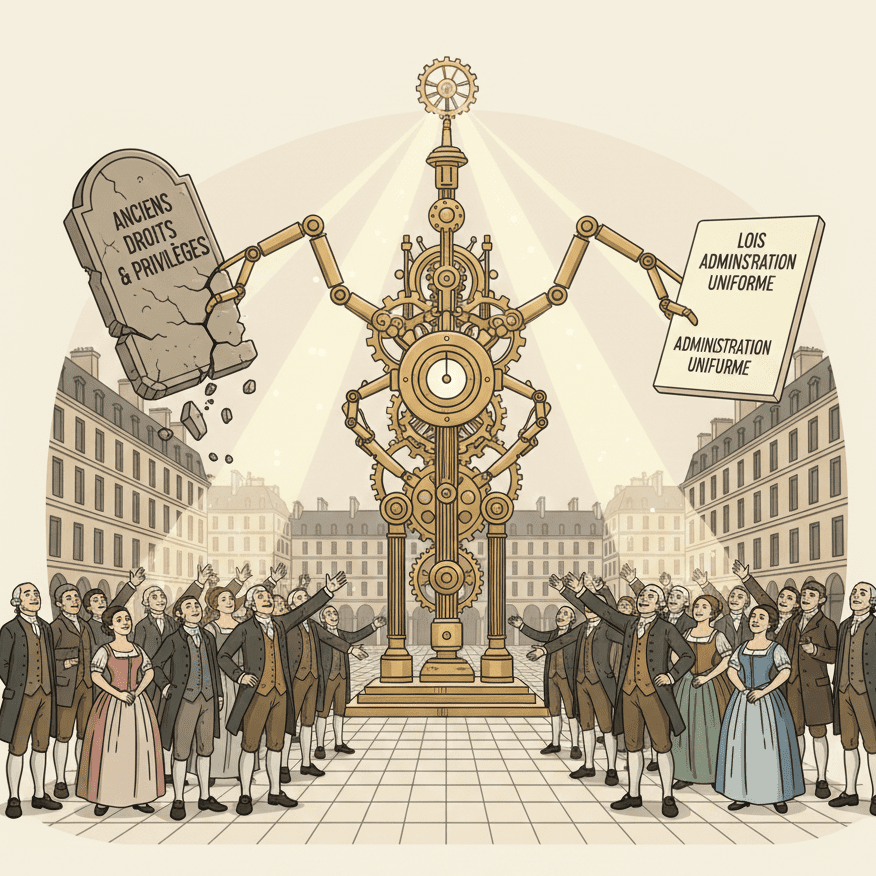
The French Revolution brought about major changes in administration aimed primarily to set up a more efficient and equitable system of governance. The government of France before the revolution was very much disunited, suffering from a situation where there were a lot of authorities with different functions working in the same area, local privileges, and pervasive corruption that was mainly affecting the upper classes, such as the nobility and clergy. This situation of inefficiency was a contributing factor to the dissatisfaction of the populace and made it clear that reforms were needed.
One of the drastic measures taken by the Revolutionary government was to reorganize the country into departments, districts, and communes, which replaced the old feudal divisions. The officials were now chosen based on their skills, inexperience, or family background. The power of the local government was now more monitored by the central authorities. Uniform laws, efficient tax collection, and greater public participation in local government matters were some of the main benefits shared by everyone as a result of these reforms.
The administrative reforms introduced during the French Revolution had a pervasive impact on France. They helped to weaken the power of aristocrats and local lords, enforced the principle of equality in the eyes of the law, and the government became more transparent and orderly through those reforms. The streamlining of administration not only facilitated the revolution to reflect its guiding principles of liberty, equality, and fraternity but also made the state stronger in the end.
4. Declaration of the Rights of Man and Citizen
Key features of the declaration
The French Revolution has been placed inextricably with the Declaration of the Rights of Man and of the Citizen (D.R.M.C.), which laid down the basic tenets of liberty, equality, and fraternity. This declaration stated that all men are free and equal in rights at birth, and it rejected any privileges based on birth or social class. It became a document that the revolutionary movement could refer to, and that modern democratic values could be built upon.
The declaration during the French Revolution brought in the features like individual freedoms protection, equality in law, and property ownership rights. Furthermore, it declared that the people’s power, not the king’s, was the source of sovereignty, and the government was for the citizens. These principles were “revolutionary.” They not only opposed absolute monarchy but also formed the basis for the notion that citizens had a say in government.
The declaration’s impact during the French Revolution was global. It was a major factor in legal, political, and social reforms, protecting citizens’ rights and minimizing the power of the state. The declaration, which played the role of a “powerhouse,” became the main source of the revolution’s ideals and later the world’s democratic movements through its advocacy of equality, liberty, and fraternity.

Equality before law
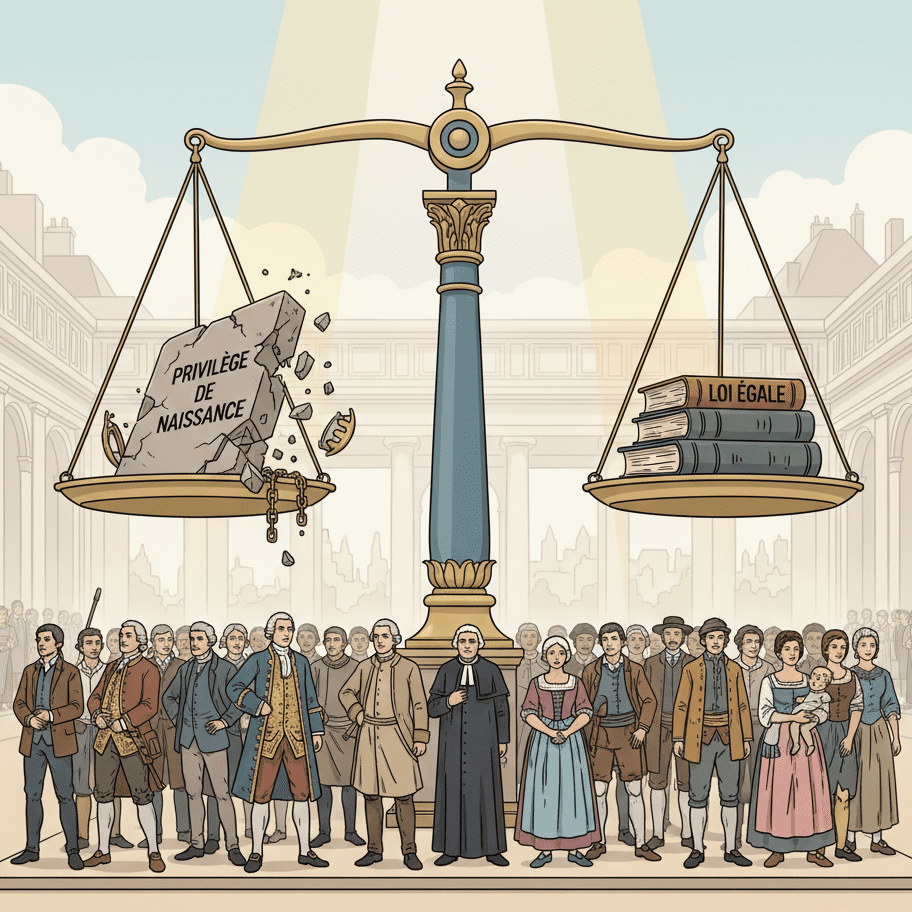
The French Revolution greatly stressed the law’s equality principle and thus took a stand against the old regime, where only the clergy and nobility had the privilege of the king’s attention in matters of law. Different classes used to be dealt with according to different laws and punishments, and frequently, the common people had to bear the brunt of the harsher treatment. Such inequality was a prime cause of public unrest, and it contributed to the call for legal reforms.
By the time of the French Revolution, reforms were set in place to treat all the people equally under the law, irrespective of their social rank. The feudal privileges of the nobility were done away with, and laws were made uniform so that every human had the same legal rights and obligations. The courts and the judicial system were restructured so that there would be no one-sidedness in the process of administering justice, making it more accessible and also impartial.
The equality before the law during the French Revolution had a long-lasting effect. It gave power to the common people, made the aristocracy less influential, and became one of the major factors in the revolutionary ideologies of liberty, equality, and fraternity. The revolution had made a launch pad for a more just and equitable society in France by the mere fact of not allowing anyone to be above the law.
Freedom of speech and expression
The French Revolution was a big step in advocating for the freedom of speech and expression as one of the primary rights. The situation was such that before the revolution, criticism of the king, the nobles, or the government, and dissent of any kind were not only looked down upon but also could result in the person concerned punished or even imprisoned. Thus, the restriction on free expression and the consequent reign of terror pushed the common people as well as the intelligentsia to shout louder for major reforms in the political setup.
The French Revolution brought with it a series of laws and changes that aimed at guaranteeing the very right of free speech, public criticism, and opinion publication, as well as active participation in debates. A very vibrant press consisting of newspapers, pamphlets, and political clubs was formed, which enabled the citizens to engage in discussions about the policies of the government and support the reformers. The entire scenario of freedom was such that it gave birth to the revolutionary thought, it was a means of drawing the people together, and also of getting the existing rulers to do their job properly by keeping them under surveillance.
The effects of the revolution in the sphere of speech and expression were nothing less than revolutionary, and they also caused huge changes as well. The rights granted by the revolution enabled the people to become the power holders and contribute to the political process, and thus rule over the society. This meant that a free society had been set up in which the individuals had the liberty to put forward their opinions, thereby contributing to the very foundation of the democratic principles in a modern way.

Limitations of the declaration
The French Revolution led to the adoption of the Declaration of the Rights of Man and of the Citizen, which proclaimed the principles of liberty, equality, and fraternity. Nevertheless, the declaration had a number of limitations since it was not applicable to all social classes to the same degree. Women, slaves in colonies, and the poorest citizens were mostly outside the cover of its protections, which was an indication that equality was not a universal right.
The declaration again suffered from practical limitations during the Revolution. Though it was theoretically a right, enforcing it was made very difficult by the political instability, wars, and resistance from the nobility and the church. Moreover, the king and his backers frequently attempted to overlook or sidestep these rights, indicating how less powerful legal proclamations could not change the established hierarchy immediately.
The limitations during the French Revolution were a signal of the gap between the revolutionary ideals and the social reality. The declaration, though imperfect, was a source of inspiration for the future movements towards human rights and legal equality. It remained a symbol of the revolution’s ideals even when society was unable to completely realize its promises of liberty, equality, and justice.

5. Role of Women in the French Revolution
Women’s participation in protests
The French Revolution opened the door for women’s participation and protests to showcase their power in the demand for social and political changes. Women, especially those living in big cities like Paris, were very upset with the high cost of food, the difficult economy, and their complete lack of political rights. By taking part in the revolution, they made it clear that this uprising was not just for men but also for women with their complaints.
The French Revolution saw women carrying out various activities in the form of marches, signing petitions, and demonstrating to express their requirements. One of the most famous events was the Women’s March on Versailles in October 1789, where thousands of women marched to complain about bread and forced the royal family to come to Paris. Even politically, women were present in clubs and debates, which proved their contribution towards building canon and revolutionary reforms.
The role of women during the revolution was considerable, but did not result in any legal rights being granted. While they could change the perspectives of the masses and the ways of the revolution, women were still mostly outside the political power and voting circles. Yet, their participation put a question mark on the existing gender roles and opened doors for future movements that would demand women’s rights and equality.
March to Versailles
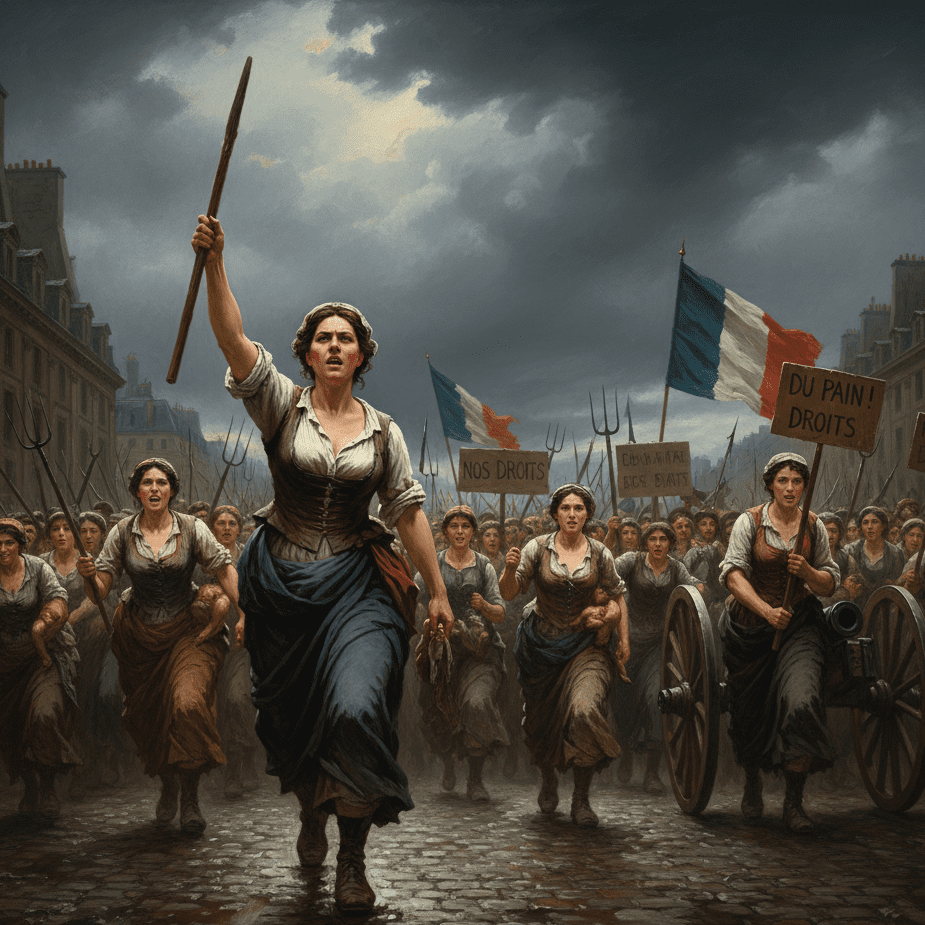
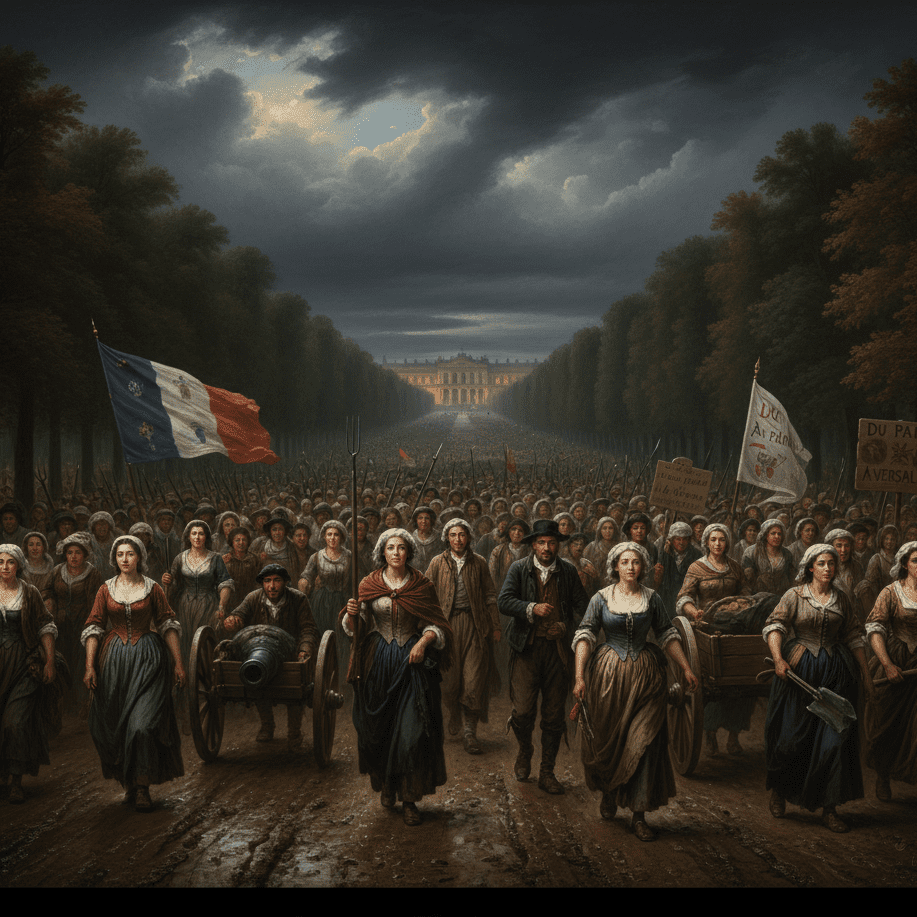
The French Revolution saw October 1789, the famous March to Versailles as a turning point. A procession of thousands of females angered by the scarcity of food and high prices of bread led a march from Paris to the royal palace, Versailles. This march not only marked the power of the populace but also the presence of the ordinary citizens in the revolutionary activities.
The marchers during the French Revolution directly approached the king and demanded his immediate intervention in the matter of the economic hardship. They were so bold as to say that the king and his family should reside in town, that is, Paris, so they could be held accountable. The march intertwined economic discontent with political claims and pointed out that the monarchy could no longer ignore the population’s wants and needs.
The March to Versailles during the French Revolution was a very powerful event. It was the reason for the king’s moving to Paris, which meant he was practically under the oversight of the revolutionaries, and the National Assembly’s power was further strengthened. The event showed the people as the increasing force in the revolution, and the future of direct action as a means for political change was thus opened.
Olympe de Gouges and women’s rights
The French Revolution was the starting point of discussions on equality, and, among others, Olympe de Gouges became the main person to cry for women’s rights. She reproached the leaders of the revolution for their male-centered view of the political reforms and composed the Declaration of the Rights of Woman and the Female Citizen in 1791. In her writings, she maintained that women had every right to enjoy legal, social, and political rights alongside men.
Olympe de Gouges not only pushed for women to be allowed into the public sphere during the French Revolution, but she also demanded that they be given the same rights as men in terms of voting, property ownership, and government positions. She not just saw the breaking of gender roles but also exposed the double standards of the revolution that claimed to be about freedom and equality while, at the same time, casting a whole gender aside. The political authorities of that time did not pay much attention to women’s demands, even though a lot of women were still active in the revolution.
Olympe de Gouges was a prominent figure during the French Revolution in the sense that she was considered to be the icon of women’s fight for equal rights. She, however, met her end at the hands of the guillotine in 1793 due to her political beliefs, but her literature empowered the coming generations to fight for women’s rights through inspiration. Her struggle made it evident that there was not only the limitation but also the opening of Gender equality in the revolutionary period.

Why women still did not get voting rights
The French Revolution was an epoch where women’s involvement in protests, debates, and even political clubs was very considerable, and they were asking for equality and rights. They had a say and the like, still, they were mostly kept outside of the political power with the formalities. The male Revolutionaries were eager to put the rights of men first; if the women were allowed such a new political power as voting, it could ruin the whole new order of society and politics.
The French Revolution was mainly about the abolition of feudal privileges and the establishment of legal equality among men. It, however, did not include women in these reforms. The declaration of rights, together with political reforms, acknowledged men as the primary citizens and women as the dependents of men or the family. Social attitudes and the fixed gender roles that were prevalent at the time also played a significant part in creating the notion that women’s involvement in politics was not only unnecessary but also rather risky.
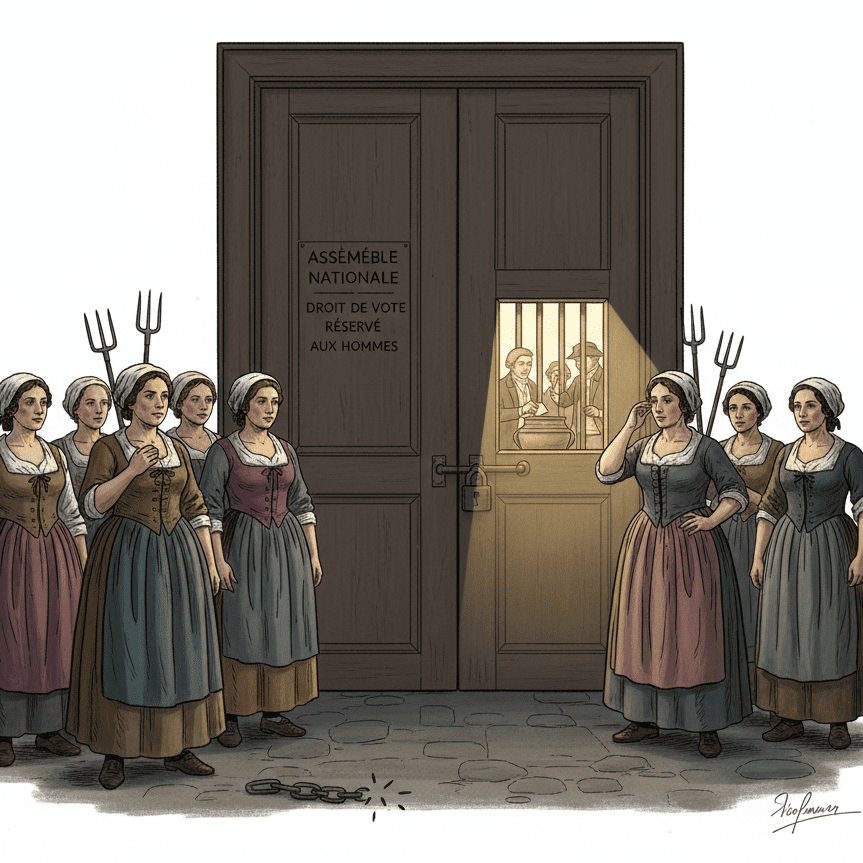
In the end, women got no voting rights along the lines of the French Revolution, notwithstanding their active role. The issue of gender inequality had been put on the agenda, and women had been given the right to vote in the future movement, but the revolution left women outside of formal political representation to a large extent. The quality of ‘liberty’ and ‘equality’ as revolutionary ideals, and through the practical application in society, became evident from this limitation.
If you have not read part 1 of it, then please visit and read it now to clear your doubt about it