The French Revolution is considered one of the most influential events in world history, not only for its impact on France but also for the spread of the revolutionary ideas to other continents. This period of the revolution emphasizes its great influence, the overthrow of the absolute monarchy, which altered the political consciousness and put in question the power of the church and the feudal system, which had been around for centuries.
One good thing that came out of the Revolution was the realization of democratic ideals like liberty, equality, and popular sovereignty, taking the front seat. These notions were not confined to France only, but they spread all around and awakened people’s consciousness to the point they would question the unjust ruling, asking for rights and aspiring for their government through representatives. It was the revolution that demonstrated the case where the political power was with the people and not with the kings and the nobles alone.
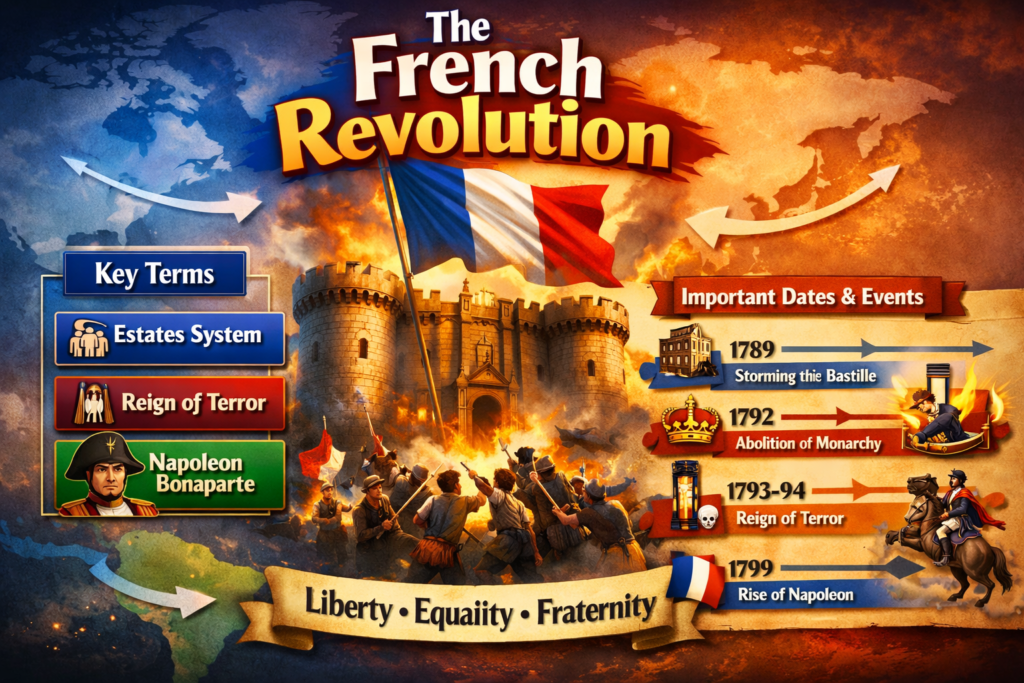
The Revolution’s impact was felt far beyond Europe. The ideas of the Revolution were the main reason for the emergence of political and social movements and reforms all along the way from the Americas to Asia, including, of course, in India, where later on the freedom fighters would draw their inspiration from the same sources of equality, justice, and anti-oppression. The revolution was a watershed for the global awakening and hence the demand for political and social changes.
To be able to comprehend the Revolution in its full extent, one should be familiar with its major terms, events, and dates first. Terms like the Ancient Regime, National Assembly, and Estates General are indispensable tools in the explanation of the demise of the old system and the rise of the new political order. A precise timeline also helps to better associate causes and effects.
At last, the French Revolution’s lessons are still very much in demand during present times. The Revolution, besides its main accomplishments, also resulted in what humans do cost. By analyzing its triumphs, failures, and consequences over the long run, we will be better equipped to understand why this revolution still has a say in the making of modern societies and the promotion of democratic values.
Table of Contents
The Impact and Legacy of the French Revolution
It was, very much, a political revolution, but one that eventually, almost everywhere, opened new horizons in people’s democratic thinking. The French Revolution affected the whole world not only by removing the king but also by questioning the most powerful pillars of the time: absolute power, social disparity, and oppression through birth. The old regime was toppled, and the new one proclaimed the rights of man, citizenship, and the people’s role in deciding their fate.
When talking about the long-term consequences of the French Revolution, modern political systems’ drastic reshaping comes first. It was the utterance of the abolition of tyrannical reigns and the encouragement of democratic movements that the world revolutions referred back to. If we analyze the impact minute by minute, it will be very clear to us why this revolution is still deemed to have changed the course of world history.
The End of the Absolute Monarchy
The French Revolution directly and powerfully resulted in the end of the absolute monarchy in France. Before the revolution, the king had omnipotent power and ruled with the divine right of kings, i.e., he was above all, and his actions were not to be judged by anyone. The revolution confronted this notion and illustrated that a monarch could be questioned, restrained, or even ousted.
King Louis XVI’s execution was an allegory of the total disintegration of the absolute monarchy during the French Revolution. It conveyed loudly that no one was above the law and that the people, not one man, were the source of all authority. This was a revolutionary thought, and it spread panic among the kings of Europe.
The decline of the absolute monarchy set a precedent for the future perception of governments. The French Revolution put an end to the so-called divine right of kings, opened the way to constitutional rule, and, together with popular sovereignty, created a model for contemporary democratic systems.
Democratic Ideals Dissemination
One of the foremost and enduring legacies of the French Revolution was that it initiated and facilitated the spread of democratic ideals like liberty, equality, and fraternity. These principles brought the concept that all citizens were, at least, equal in the eyes of the law and entitled to basic rights, regardless of birth or social status. This was a dramatic turn from the feudal and aristocratic regimes.
The foundation of modern democracies and constitution-making was the principles of the Declaration of the Rights of Man and of the Citizen, freedom of speech, law-abidingness, and protection of individual rights.
Before long, these democratic values were travelling beyond the borders of the nations. The Revolution had prompted the raising of questions about injustices in various parts of the world, seeking rights and representative governments, and thus transforming democracy into an aspiration shared globally rather than an experiment confined to a few localities.
Power to Europe and the Entire World
The change brought by the French Revolution reverberated throughout Europe. The neighboring kings were afraid of revolts, similar to the French Revolution happening in their own domains, while the masses, in turn, found in revolutionary ideas the source of their hope and inspiration. The revolutionary government of France took the initiative of spreading these ideas through wars and reforms quite actively.
More than one European country came under the influence of the French Revolution and embarked on a journey of political reforms and nationalist progress. The aristocratic privileges were called into question, and the old socio-economic structure was beleaguered, while the notion became powerful. The rulers who were against the revolution ended up implementing limited reforms on their own.
The French Revolution thrust itself into the limelight of the world as a universal symbol of the fight against tyranny. It enlightened the world that common people could oppose even the strongest powers, thereby operating as a motivational factor for the political upheavals in different parts of the world.
Impact On India And Other Revolutions
The concepts of the French Revolution, among others, came over to India and also influenced the European colonies‘ freedom movements. The Indian leaders and thinkers later used the principles of liberty, equality, and national sovereignty to strengthen their cases when they were struggling against the colonizers.
Not only the French Revolution but also the Latin American independence movements have been living under the wing of the latter. The Revolution picked the times when the leaders of the new world had decided to be called and to use the power of the people and their equality as the basis for their new nations instead of the colonial powers.
In the end, the French Revolution became a worldwide reference point for the struggle and the quest for social and political change. Its influence on India and other revolutions is the case of one historical event shaping global fights for freedom, justice, and democracy through many generations.
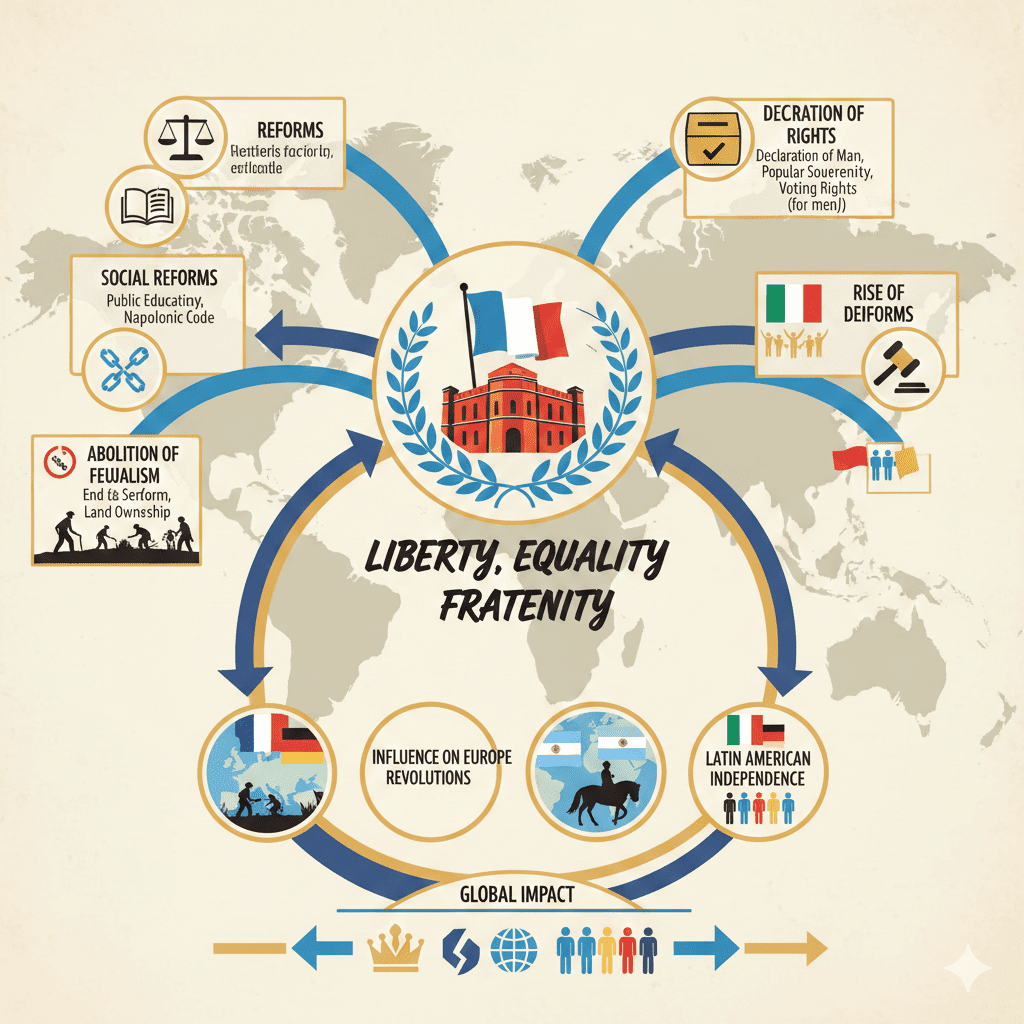
Key Terms and Important Definitions
Familiarity with some key terms is necessary if one wants to comprehend the French Revolution in its entirety. These very terms elucidate the functioning of French society and politics in the pre-revolutionary and revolutionary period. Such terms not only make the revolution easier to follow and analyze but also provide a clear and meaningful way to connect events, ideas, and actions.
The concepts highlighted here are the basis of the French Revolution. They reveal the reasons behind the people’s uprising, the transfer of power from the monarchy to the people, and the establishment of new political institutions. Each term embodies a different phase of the revolution while bringing to the fore the change in French society.
Ancient Regime
Ancient Regime denotes the former system of governance and social stratification that was in place in France prior to the Revolution. The monarch had complete control over the land and people, and the entire population was categorized into three unequal estates—the clergy, nobility, and common people. The privileges of the upper classes were determined by birth, not capabilities, leading to great disparity in society.
For the ordinary folk, the consequences of the Ancient Regime were exorbitant taxes, political powerlessness, and poverty. The members of the First and Second Estates not only received but also shared the burden of taxation. This inequality of privileges and rights became the main reason for the people’s discontent, which ultimately resulted in the French Revolution.
The end of the Ancient Regime represented the end of the feudal system with its privileges and the absolute monarchy. Its downfall was a signal of a drastic change and the beginning of an era of equality, citizenship, and constitutional rule.
Guillotine
One of the most potent and controversial emblems of the French Revolution, the guillotine, made its appearance at that time. It was projected as a humane and equal method of execution, meant to give a quick death to a person, irrespective of their social position. The guillotine, in theory, was a reflection of the revolutionary idea of equality before the law.
The guillotine was during the Reign of Terror, the main instrument of killing for those who were in the category of enemies of the revolution. Nobles, revolutionaries, and even non-revolutionaries were sent to the guillotine for merely being unpopular with the revolution. The extensive use created fear and brought to light the negative aspect of the French Revolution.
Through the lens of the justice system, the guillotine was perceived, but slowly it turned into a symbol of bloodshed and extravagance. The legacy of the guillotine is a reminder that the French Revolution was a very dramatic affair, with the human toll being huge, while the Revolution’s ultimate aims were liberty and equality.
Jacobins Club
Jacobins were the most radical of all the political factions in the French Revolution. They were supportive of a strong central government, equality, and stern measures against the enemies of the revolution. The Jacobins during the unification period of the revolution, which saw Robespierre as one of their leaders, influenced the revolution the most.
They played a crucial role in the overthrow of the monarchy and the establishment of the French Republic. They were in favour of the imposition of restrictions on the prices of commodities, universal male voting rights, and the execution of the people accused of being counter-revolutionaries. Their policies exposed their belief in victory through the means of strong and decisive action.
But the Jacobins also became synonymous with repression and violence during the Terror period. Their rise and fall depict how the French Revolution oscillated between justice and the dangers of tyrannical power in the name of revolution.
National Assembly
The National Assembly was the assembly formed by Third Estate representatives, and it was the most important institution of the French Revolution. It declared itself the representative of the French nation instead of the privileged classes or the king. This was a big new step in the power circle.
The National Assembly took one of the very important steps to draft the new constitution and get rid of feudalism. It tried to secure equality before the law and restrict the monarchy’s power. These measures were the groundwork for constitutional government in France.
The birth of the National Assembly was a sign of the people’s power during the French Revolution. It proved that political authority could come from the people’s delegates, not only from the royal power.
Estates General
The Estates General was the old-style assembly that consisted of representatives of the three estates of French society. It was summoned in 1789 to deal with the French financial crisis, but it soon turned into a pivotal moment in the French Revolution. Its very setup revealed the vast unfairness that existed in French society.
Each of the three estates had one vote; consequently, the clergy and nobility, even though they were only a small minority, could always outvote the Third Estate. This ridiculous voting system caused conflict and anger among the representatives of the common people, which made the revolutionary movement go on.
The Estates General not succeeding was the reason directly leading to the National Assembly being formed. So, in this way, it was the beginning of the French Revolution, the revolution turning a financial dispute into a political and social one.
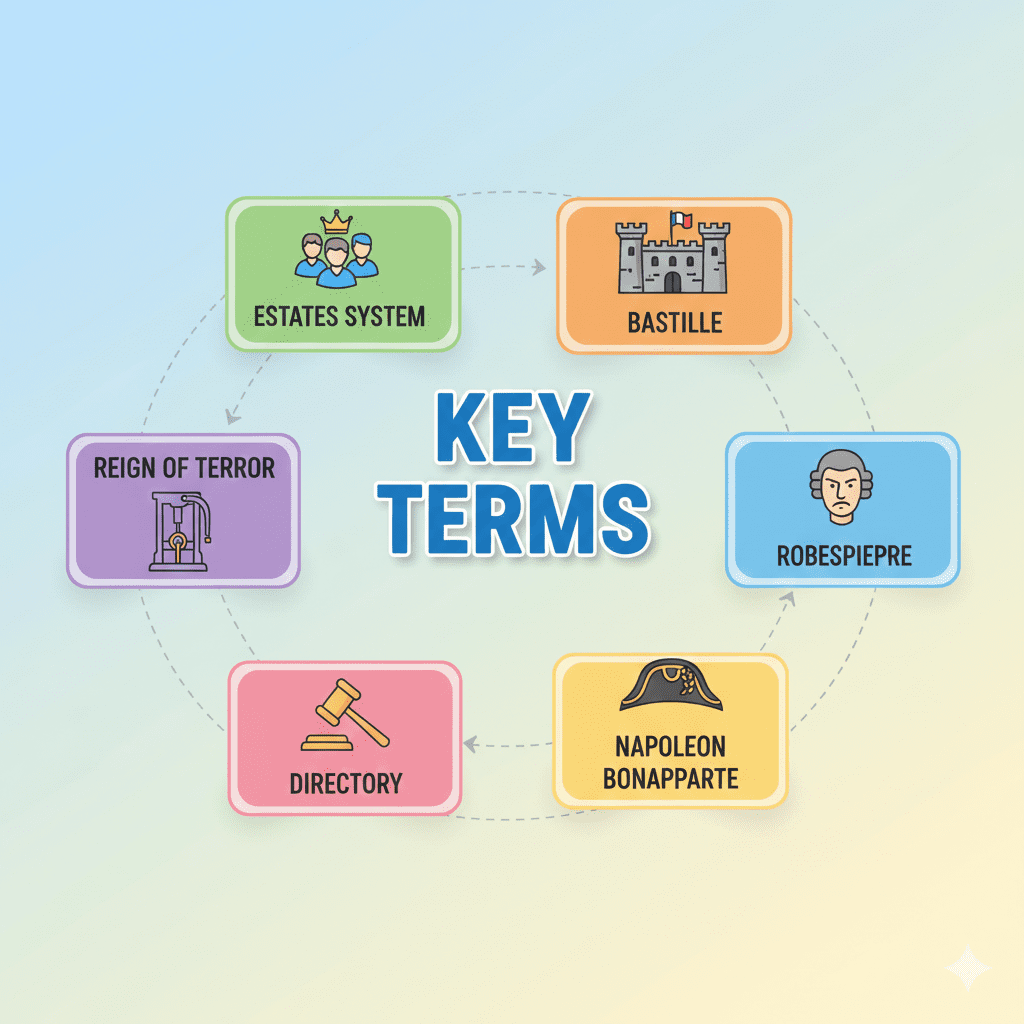
Important Dates and Events of the French Revolution
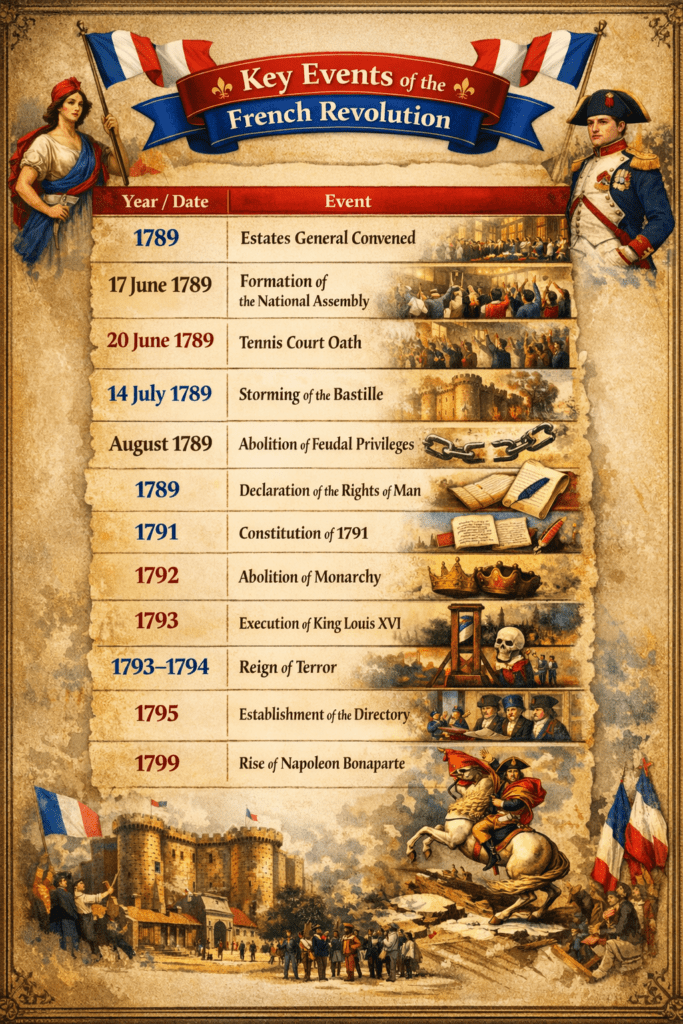
The revelation of the French Revolution is to be seen more clearly when a proper order of its major events has been sorted out. The dates and the events aid in the visibility of the revolution’s development step by step—from the financial crisis to the fall of the monarchy, to the rise of radical politics, and finally, to the emergence of Napoleon. Without the timeline, the revolution might seem to be a series of confusing and disconnected events.
The significance of the dates in the French Revolution is to be found in the cause-and-effect relationship between the events. Major occurrences each triggered the next stage of change. Hence, historians and students often resort to chronological tables and one-line explanations for quick revision and conceptual clarity.
Chronological Table of Major Events
One of the best means of revising the German Revolution is through a chronological table. It simplifies and structures complex historical developments straightforwardly. By following the timeline, we would be able to decipher the unfolding of political, social, and economic changes over time.
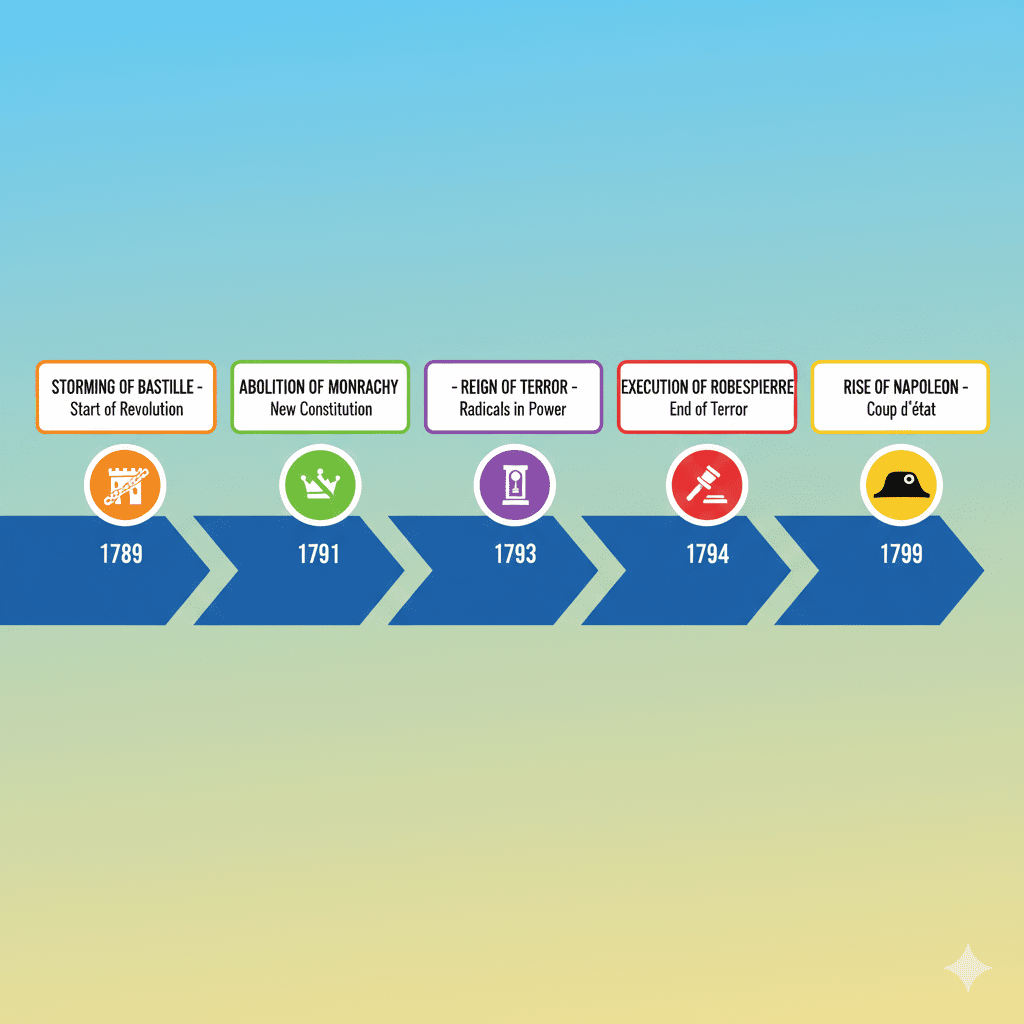
This time frame makes it evident how the French Revolution progressed from reform to radicalism. The earlier events were concentrated on the power of the king being curtailed, and the later ones indicated the instability and violence of the politics. Besides, the table is very useful for exam preparation since many questions are directly related to the dates and sequences.
Above all, the chronological method reveals how fast France underwent a change within one decade. The French Revolution was not a gradual process but rather an intense, rapid, and transformative one.
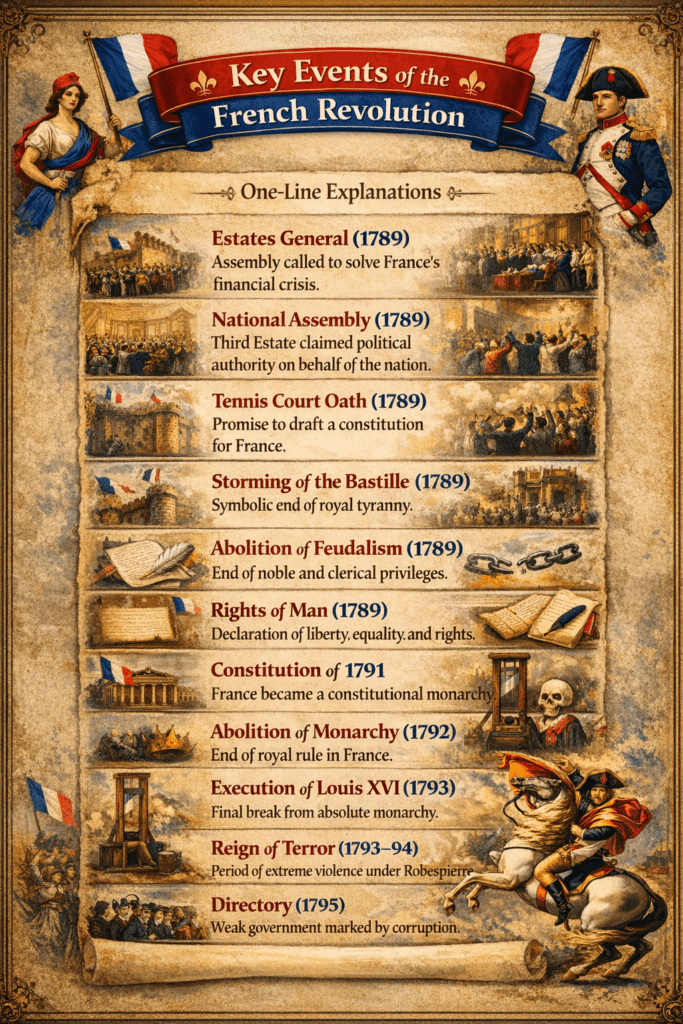
One-Line Explanations
The French Revolution and are therefore recommended for quick revision just before the exams. Each line expresses the main idea of the event without unnecessary detail. This method works really well for students who need to get clarified with less time.
Moreover, these short explanations also aid the logical connection of events. When read in sequence, they illustrate the flow of The French Revolution from non-violent reforms to bloody changes and eventually political lull with Napoleon.
The following are the short descriptions that encapsulate the major occurrences of The French Revolution.
Frequently Asked Questions
- The French Revolution began in
A) 1776
B) 1787
C) 1789
D) 1799
Ans: C - France before the revolution was ruled by
A) Democracy
B) Republic
C) Absolute Monarchy
D) Military rule
Ans: C - The old regime of France was called
A) Republic
B) Directory
C) Ancient Régime
D) Commune
Ans: C - Which estate paid maximum taxes?
A) Clergy
B) Nobility
C) Third Estate
D) King
Ans: C - Who belonged to the Third Estate?
A) Nobles
B) Clergy
C) Peasants and workers
D) Royal family
Ans: C - The main cause of financial crisis was
A) Industrial loss
B) Costly wars
C) Natural disasters
D) Trade ban
Ans: B - The American War of Independence affected France by
A) Increasing income
B) Creating debt
C) Ending monarchy
D) Strengthening king
Ans: B - Bread shortage mainly affected
A) Nobles
B) Clergy
C) Peasants
D) Army
Ans: C - Philosopher who wrote Social Contract
A) Voltaire
B) Rousseau
C) Montesquieu
D) Locke
Ans: B - Idea of separation of powers was given by
A) Rousseau
B) Voltaire
C) Montesquieu
D) Hobbes
Ans: C
11. Who is known as the ‘Father of Modern Political Philosophy’ and influenced revolutionary ideas in France?
A) Voltaire
B) Montesquieu
C) John Locke
D) Rousseau
Answer: C) John Locke
12. Which Enlightenment thinker advocated for the separation of powers in government?
A) Voltaire
B) Montesquieu
C) Rousseau
D) Diderot
Answer: B) Montesquieu
13. Who emphasized freedom of speech and criticized the Catholic Church?
A) Rousseau
B) Voltaire
C) Montesquieu
D) Hobbes
Answer: B) Voltaire
14. The Third Estate in pre-revolutionary France consisted of:
A) Clergy
B) Nobility
C) Common people
D) Royal family
Answer: C) Common people
15. Which estate was exempt from most taxes?
A) First Estate
B) Second Estate
C) Third Estate
D) None
Answer: A) First Estate and B) Second Estate (Both exempted)
16. What was the main cause of the financial crisis in France before 1789?
A) Poor agriculture
B) Costly wars and royal extravagance
C) High unemployment
D) Population decline
Answer: B) Costly wars and royal extravagance
17. Who was the King of France at the time of the Revolution?
A) Louis XIV
B) Louis XV
C) Louis XVI
D) Charles X
Answer: C) Louis XVI
18. Marie Antoinette was the queen of France. Where was she originally from?
A) Austria
B) Prussia
C) Spain
D) Italy
Answer: A) Austria
19. Which of the following was a reason for public hatred towards Marie Antoinette?
A) Her political reforms
B) Her lavish spending
C) Her military victories
D) Her tax reforms
Answer: B) Her lavish spending
20. The famine in France during the late 1780s was caused by:
A) War only
B) Poor harvests
C) Excessive taxation
D) Inflation only
Answer: B) Poor harvests
21. Which of the following best describes unemployment in France before the Revolution?
A) Rare and localized
B) Widespread due to economic crisis
C) Limited to clergy
D) Only affected nobles
Answer: B) Widespread due to economic crisis
22. Which tax was specifically imposed on peasants in France?
A) Taille
B) Capitation
C) Gabelle
D) All of the above
Answer: D) All of the above
23. The Estates-General was called in 1789 to:
A) Elect a new king
B) Solve the financial crisis
C) End famine
D) Reform the military
Answer: B) Solve the financial crisis
24. Which estate had the least political representation despite forming the majority of the population?
A) First Estate
B) Second Estate
C) Third Estate
D) Royal family
Answer: C) Third Estate
25. “Liberty, Equality, Fraternity” was the key idea of:
A) American Revolution
B) Industrial Revolution
C) French Revolution
D) Renaissance
Answer: C) French Revolution
26. Which Enlightenment thinker wrote the book The Social Contract?
A) Voltaire
B) Rousseau
C) Montesquieu
D) Locke
Answer: B) Rousseau
27. What was one major effect of the Estates system on French society?
A) Equal wealth distribution
B) Social inequality and resentment
C) Strong monarchy
D) Industrial growth
Answer: B) Social inequality and resentment
28. Which luxury item was Marie Antoinette famously associated with?
A) Shoes
B) Jewelry
C) Dresses
D) Hats
Answer: C) Dresses
29. What was the financial burden on the Third Estate mainly used for?
A) Public welfare
B) Supporting the royal court and clergy
C) Education
D) Trade expansion
Answer: B) Supporting the royal court and clergy
30. The immediate economic cause of unrest among common people in France was:
A) High taxes and rising food prices
B) Spread of Enlightenment ideas
C) Religious persecution
D) Industrialization
Answer: A) High taxes and rising food prices
31. The famous phrase “Let them eat cake” is often wrongly attributed to:
A) Louis XVI
B) Marie Antoinette
C) Robespierre
D) Napoleon
Answer: B) Marie Antoinette
32. Which group primarily led the early protests during the French Revolution?
A) Clergy
B) Nobility
C) Bourgeoisie and commoners
D) Royal army
Answer: C) Bourgeoisie and commoners
33. Which of the following was NOT a cause of the French Revolution?
A) Influence of Enlightenment thinkers
B) Heavy taxation on peasants
C) Absolute monarchy
D) Industrial revolution
Answer: D) Industrial revolution
34. Louis XVI’s attempts at tax reforms were:
A) Accepted by all estates
B) Rejected by privileged classes
C) Ignored by commoners
D) Supported by nobles only
Answer: B) Rejected by privileged classes
35. What major problem worsened the impact of famine?
A) Poor agricultural technology
B) Inefficient transport and storage
C) Corruption in grain distribution
D) All of the above
Answer: D) All of the above
36. Which Enlightenment idea inspired the Third Estate to demand political rights?
A) Absolutism
B) Social contract and equality
C) Divine right of kings
D) Mercantilism
Answer: B) Social contract and equality
37. Which crisis made the French monarchy weak and unpopular by 1789?
A) Political only
B) Economic only
C) Social only
D) All of the above
Answer: D) All of the above
38. Before the Revolution, who had the power to approve new taxes?
A) Estates-General
B) King alone
C) Nobles
D) Church
Answer: B) King alone
39. Which crop failure added to the public discontent in France?
A) Rice
B) Wheat
C) Corn
D) Barley
Answer: B) Wheat
40. Which of the following best describes Louis XVI’s personality according to historians?
A) Strong and decisive
B) Weak and indecisive
C) Revolutionary-minded
D) Militarily skilled
Answer: B) Weak and indecisive
- Estates General was called in
A) 1787
B) 1788
C) 1789
D) 1791
Ans: C - Voting controversy was about
A) Tax voting
B) One vote per estate
C) One vote per citizen
D) Military voting
Ans: B - The National Assembly was formed by
A) Nobility
B) Clergy
C) Third Estate
D) King
Ans: C - Tennis Court Oath was taken in
A) Parliament
B) Church
C) Palace hall
D) Tennis court
Ans: D - Bastille was a
A) School
B) Market
C) Prison
D) Palace
Ans: C - Bastille was stormed on
A) 10 July 1789
B) 12 July 1789
C) 14 July 1789
D) 20 July 1789
Ans: C - 14 July is celebrated as
A) Republic Day
B) Freedom Day
C) National Day of France
D) Victory Day
Ans: C - Feudal privileges were abolished in
A) 1789
B) 1791
C) 1792
D) 1793
Ans: A - Rights of Man declared equality for
A) Nobles only
B) Clergy only
C) All men
D) King
Ans: C - Constitution of 1791 made France a
A) Republic
B) Dictatorship
C) Constitutional Monarchy
D) Empire
Ans: C
- The Jacobins were
A) Moderates
B) Royalists
C) Radicals
D) Conservatives
Ans: C - The Jacobins met in a former
A) Palace
B) Church
C) School
D) Court
Ans: B - Leader of the Jacobins was
A) Danton
B) Marat
C) Robespierre
D) Napoleon
Ans: C - The Girondins were
A) Extreme radicals
B) Moderate revolutionaries
C) Royal supporters
D) Military leaders
Ans: B - Girondins mainly represented
A) Paris workers
B) Rural peasants
C) Wealthy middle class
D) Nobility
Ans: C - Which group supported the Reign of Terror?
A) Girondins
B) Jacobins
C) Royalists
D) Clergy
Ans: B - Active citizens were those who
A) Paid taxes
B) Owned land
C) Paid a certain amount of taxes
D) Were nobles
Ans: C - Passive citizens were
A) Taxpayers
B) Non-taxpayers
C) Soldiers
D) Nobles
Ans: B - Active citizens had the right to
A) Work
B) Vote
C) Protest
D) Revolt
Ans: B - Passive citizens were mostly
A) Clergy
B) Nobility
C) Poor men and women
D) Kings
Ans: C - The concept of Active and Passive citizens was introduced by
A) Jacobins
B) Constitution of 1791
C) National Convention
D) Directory
Ans: B - Which right was denied to women?
A) Education
B) Property
C) Voting
D) Speech
Ans: C - Olympe de Gouges fought for
A) Monarchy
B) Women’s rights
C) Nobility rights
D) Church power
Ans: B - Women marched to Versailles mainly for
A) Voting rights
B) Employment
C) Bread
D) Education
Ans: C - Political clubs helped by
A) Spreading ideas
B) Raising taxes
C) Supporting king
D) Ending debates
Ans: A - Jacobins wore
A) Blue coats
B) Green jackets
C) Long trousers
D) Royal robes
Ans: C - Jacobins represented
A) Nobility
B) Clergy
C) Lower classes
D) Kings
Ans: C - Girondins opposed
A) Republic
B) Violence
C) Constitution
D) Voting
Ans: B - Radical phase of the French Revolution began in
A) 1789
B) 1791
C) 1792
D) 1795
Ans: C - Political clubs increased
A) Unity
B) Public awareness
C) Royal power
D) Church influence
Ans: B
- Monarchy was abolished in
A) 1789
B) 1791
C) 1792
D) 1793
Ans: C - France became a republic in
A) 1789
B) 1791
C) 1792
D) 1795
Ans: C - The National Convention declared France a
A) Monarchy
B) Republic
C) Empire
D) Dictatorship
Ans: B - King Louis XVI was executed in
A) 1791
B) 1792
C) 1793
D) 1794
Ans: C - Louis XVI was executed by
A) Hanging
B) Shooting
C) Guillotine
D) Poison
Ans: C - Execution of the king symbolized
A) Strength of monarchy
B) End of absolutism
C) Foreign invasion
D) Church dominance
Ans: B - Which class supported abolition of monarchy?
A) Nobility
B) Clergy
C) Third Estate
D) Kings
Ans: C - The fall of monarchy led to
A) Stability
B) Peace
C) Political chaos
D) Economic growth
Ans: C - France faced war with
A) Asia
B) Africa
C) European monarchies
D) America
Ans: C - Foreign rulers feared
A) Napoleon
B) Spread of revolution
C) Trade loss
D) Church decline
Ans: B - Republic stood for
A) King’s rule
B) People’s rule
C) Military rule
D) Church rule
Ans: B - The National Convention represented
A) Only nobles
B) Only clergy
C) People of France
D) Kings
Ans: C - Execution of Louis XVI shocked
A) France only
B) Asia
C) Europe
D) America
Ans: C - The abolition of monarchy increased
A) Equality
B) Slavery
C) Privilege
D) Nobility power
Ans: A - Republican government faced
A) Stability
B) Peace
C) Economic crisis
D) Prosperity
Ans: C - The republic was supported by
A) Jacobins
B) Royalists
C) Clergy
D) Nobles
Ans: A - Royalists wanted to
A) Abolish king
B) Restore monarchy
C) Support republic
D) End voting
Ans: B - Guillotine symbolized
A) Justice
B) Equality before law
C) Violence
D) All of the above
Ans: D - The republic abolished
A) Equality
B) Voting
C) Titles
D) Taxes
Ans: C - Republic period was marked by
A) Peace
B) Stability
C) Fear and conflict
D) Growth
Ans: C
- The Reign of Terror began in
A) 1791
B) 1792
C) 1793
D) 1795
Ans: C - Main aim of Terror was to
A) Spread peace
B) Remove enemies
C) Support king
D) End republic
Ans: B - Revolutionary Tribunal was set up to
A) Teach law
B) Judge enemies
C) Support monarchy
D) End executions
Ans: B - Law of Suspects allowed
A) Free speech
B) Arrest without proof
C) Voting rights
D) Trade freedom
Ans: B - Maximum executions occurred under
A) Girondins
B) Jacobins
C) Directory
D) Napoleon
Ans: B - Terror was justified as
A) Necessary evil
B) Moral act
C) Religious duty
D) Economic reform
Ans: A - Robespierre believed terror was
A) Unjust
B) Temporary
C) Necessary for virtue
D) Wrong
Ans: C - Victims of Terror included
A) Nobles only
B) Clergy only
C) All classes
D) Foreigners only
Ans: C - End of Terror came with
A) Death of Louis XVI
B) Fall of Robespierre
C) Rise of Napoleon
D) Directory
Ans: B - Robespierre was executed in
A) 1793
B) 1794
C) 1795
D) 1799
Ans: B - The fall of Jacobins led to
A) Monarchy
B) Stability
C) Directory
D) Empire
Ans: C - Terror weakened
A) Church
B) Monarchy
C) Republic’s support
D) Economy only
Ans: C - Terror mainly affected
A) Rich
B) Poor
C) Political opponents
D) Kings
Ans: C - Reign of Terror ended in
A) Peace
B) Chaos
C) Military rule
D) Strong republic
Ans: B - The French Revolution showed
A) Violence only
B) Power of people
C) Failure of ideas
D) End of democracy
Ans: B - Political instability increased after
A) Bastille
B) Constitution of 1791
C) Execution of king
D) Tennis Court Oath
Ans: C - Terror reduced
A) Fear
B) Violence
C) Freedom
D) Equality
Ans: C - Jacobin rule was
A) Democratic
B) Authoritarian
C) Monarchical
D) Religious
Ans: B - Committee of Public Safety was led by
A) Napoleon
B) Danton
C) Robespierre
D) Louis XVI
Ans: C - Terror was opposed by
A) Jacobins
B) Girondins
C) Clergy
D) Peasants
Ans: B - Guillotine executions aimed to
A) Entertain
B) Control opposition
C) Educate people
D) Reform law
Ans: B - Terror created
A) Equality
B) Unity
C) Fear
D) Growth
Ans: C - The radical phase of the French Revolution is linked to
A) 1789–90
B) 1791–92
C) 1793–94
D) 1795–99
Ans: C - Robespierre believed in
A) Absolute monarchy
B) Moral republic
C) Empire
D) Capitalism
Ans: B - The Terror damaged the image of
A) King
B) Church
C) Revolution
D) Nobility
Ans: C - After Terror, people wanted
A) More violence
B) Stability
C) Monarchy
D) War
Ans: B - End of Terror led to
A) Jacobin rule
B) Girondin return
C) Directory
D) Empire
Ans: C - The Terror proved that
A) Ideals were easy
B) Power corrupts
C) Kings were good
D) Revolution failed
Ans: B - The French Revolution entered a new phase after
A) 1789
B) 1791
C) 1794
D) 1799
Ans: C - These events show that The French Revolution was
A) Simple
B) Peaceful
C) Complex
D) Short
Ans: C