
Introduction
In recent years, blogging has experienced a comprehensive revolution, with artificial intelligence redefining how content is created, optimized, and shared.
Tasks that once demanded hours of brainstorming, drafting, and editing are now accelerated by intelligent writing assistants.
These powerful tools enable bloggers to spark fresh ideas, build structured outlines, refine grammar, and even enhance search engine visibility, all without spending a single rupee.
In 2026, free AI writing tools will be more powerful than ever, offering features that rival premium platforms. Whether you’re just beginning your journey and eager to publish your very first blog or a seasoned blogger aiming to scale content production, the right AI assistant can save time, boost creativity, and improve quality.
This guide reviews the 12 best free AI writing tools for bloggers in 2026, showcasing their key features, pros and cons, and real‑world use cases.
Best Free AI Writer (Quick List)
- ChatGPT – Best Overall Assistant
- Claude – Works Best with Lengthy Content
- Writesonic – Best for SEO blog writing
- Copy.ai – Best Choice for Creating Ads and Marketing Content
- Rytr – Best for beginners
- Grammarly – Best Choice for Polishing Grammar and Style
- Notion AI – Best productivity workspace
- QuillBot – Best paraphrasing tool
- Simplified – Best all-in-one content tool
- Scalenut – Best for SEO optimization
- Gemini – Perfect Fit for Google Ecosystem
- Perplexity – Best for research and AI search
Table of Contents
1. How AI Writing Tools Work
AI writing platforms rely on Natural Language Processing (NLP) and large datasets to generate human‑like text. Imagine typing a prompt into the tool, for example, “Write an introduction about digital marketing.” The AI analyzes context, predicts the next words, and produces structured content.
The process usually involves:
- Prompt Input – You give a short instruction.
- AI Processing – The model interprets grammar, tone, and meaning.
- Content Generation – A draft, outline, or full article is produced instantly.
This workflow allows bloggers to move from idea to draft in minutes, freeing up time for strategy and creativity.
2. Benefits of Using Free AI Writers
Free AI tools offer several advantages:
- Speed – Generate outlines or full articles in seconds.
- Productivity – Create multiple drafts or variations quickly.
- SEO Support – Many tools suggest keywords and headings.
- Cost Efficiency – No need for expensive subscriptions.
- Idea Generation – AI can brainstorm topics when inspiration runs dry.
For instance, a technology blogger could prompt the tool with: “Suggest beginner topics about artificial intelligence.” The AI could propose ideas like AI in everyday life or AI tools for students.
3. Key Features Bloggers Should Look For
When choosing an AI writing tool, pay attention to:
- Text Generation – Ability to create blogs, ads, and captions.
- Grammar & Editing – Improves readability and tone.
- SEO Optimization – Helps rank content on Google.
- Templates – Pre‑built structures for faster writing.
- Multi‑Language Support – Useful for global audiences.
- Plagiarism Detection – Ensures originality.
Read more related blogs: Visit Now
4. ChatGPT – Best Overall Assistant
ChatGPT, developed by OpenAI and launched in 2022, is a conversational AI built on GPT architecture. It understands natural language to assist with writing, research, coding, learning, and problem‑solving, making advanced AI accessible and practical for bloggers, students, and professionals.
Strengths:
- Conversational interface feels natural.
- Supports multiple languages.
- Great for brainstorming and learning.
Limitations:
- May produce outdated or inaccurate facts.
- Requires clear prompts for best results.
5. Claude – Works Best with Lengthy Content
Claude, developed by Anthropic in 2021, is an instance that a technology blogger could prompt the tool with: ‘Suggest problem-solving. Built with a focus on safety and reliability, it helps users handle complex instructions and produce high-quality content efficiently.
Strengths:
- Processes long documents effectively.
- Safety‑focused design ensures reliable outputs.
Limitations:
- Some advanced features require payment.
- Occasional fact‑checking needed.
6. Writesonic – Best for SEO Blogging
Writesonic, launched in 2020 by Samanyou Garg, is an AI‑powered content platform that helps bloggers, marketers, and businesses quickly create high‑quality blogs, ads, and social media posts using advanced natural language processing.
Strengths:
- Built‑in keyword optimization.
- Ready‑made templates designed for ads, blog posts, and landing pages.
Limitations:
- The free plan has usage limits.
- Text may sound repetitive without editing.
7. Copy.ai – Best Choice for Creating Ads and Marketing Content
Copy.ai, founded in 2020 by Chris Lu and Paul Yacoubian, is an AI writing platform that helps marketers, bloggers, and businesses overcome writer’s block and quickly create high‑quality content by automating repetitive tasks.
Strengths:
- Beginner‑friendly interface.
- Fast generation of marketing content.
Limitations:
- Long‑form content may need polishing.
- The free plan provides only a basic set of features.
8. Rytr – Best for Beginners
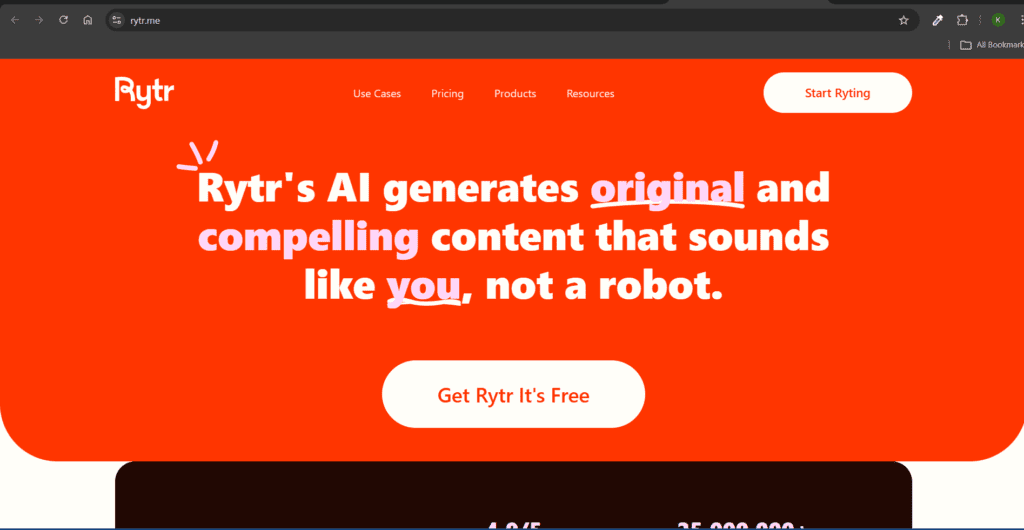
Rytr is simple, affordable, and supports over 40 content types.
Strengths:
- Perfectly suited for new bloggers thanks to its intuitive design.
- Supports multiple tones and languages.
Limitations:
- Limited SEO features.
- Free plan restricts character count.
9. Grammarly -Best Choice for Polishing Grammar and Style
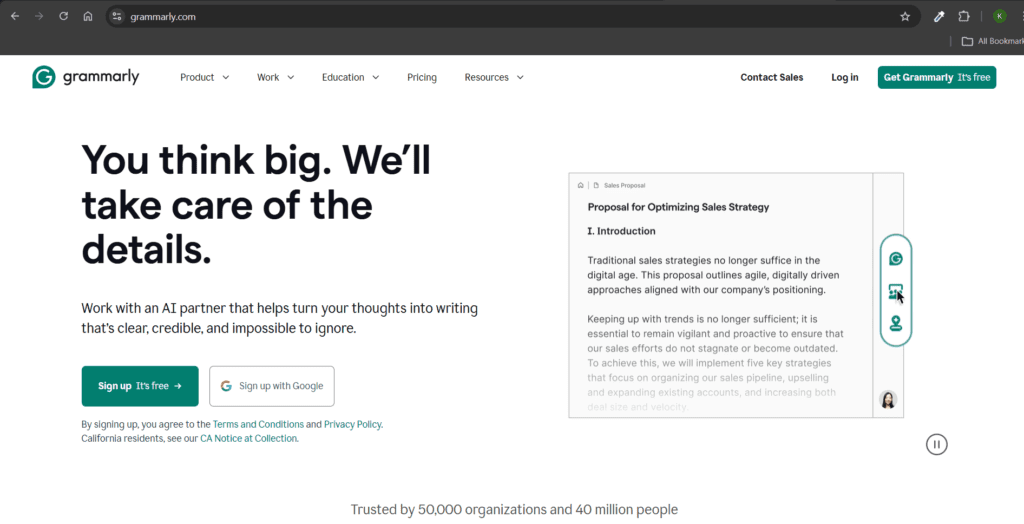
Grammarly was introduced in 2009 by Alex Shevchenko, Max Lytvyn, and Dmytro Lider, and it quickly became a go‑to platform for grammar and editing support. Powered by NLP, it helps students, professionals, and businesses write error‑free, polished content.
Strengths:
- Real‑time corrections.
- Works across browsers and apps.
Limitations:
- Advanced features require a premium.
- Limited support for non‑English languages.
10. Notion AI – Best Productivity Workspace
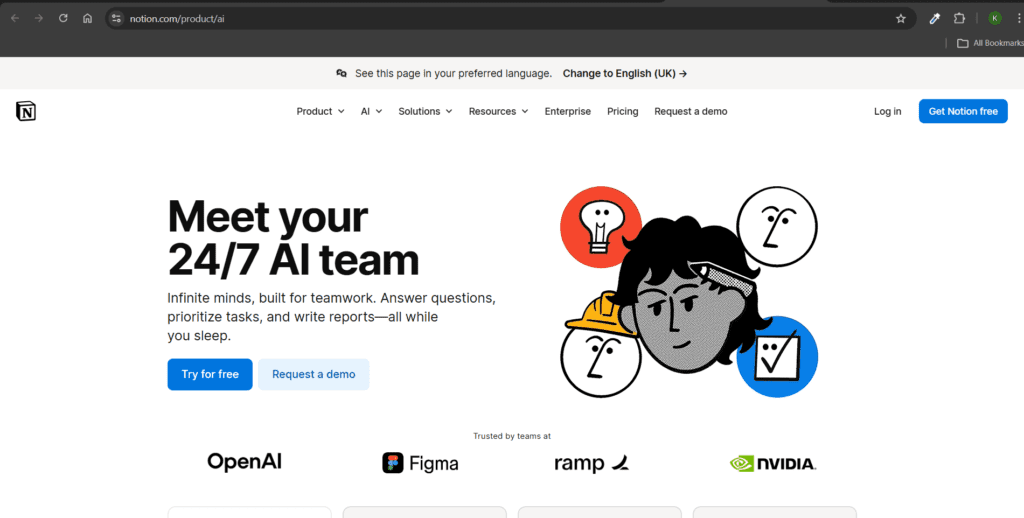
Notion AI, launched by Notion Labs, is an AI assistant built into the Notion workspace. It helps users write, organize, and manage projects by generating content, summarizing information, and automating repetitive tasks to boost productivity.
Strengths:
- Summarizes notes and documents.
- Boosts productivity with automation.
Limitations:
- Less specialized than dedicated writing tools.
- Some features are locked behind paid plans.
11. QuillBot – Best Paraphrasing Tool
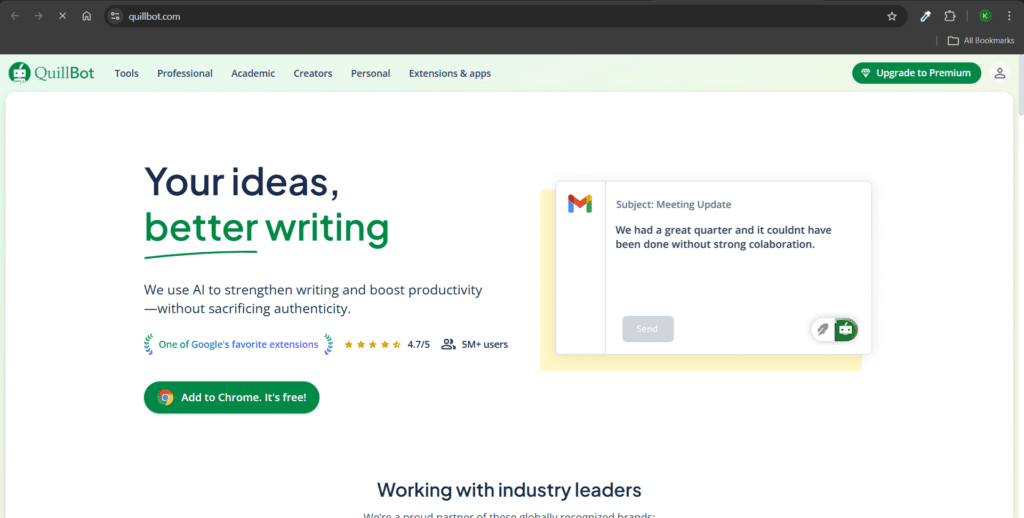
QuillBot, co‑founded by Rohan Gupta and now part of Course Hero, is an AI‑powered writing assistant designed to help students, bloggers, and professionals paraphrase, summarize, and refine text with ease-enhancing clarity, efficiency, and overall communication quality.
Strengths:
- Flexible writing modes let you switch between Standard, Creative, and Formal styles effortlessly.
- Strong paraphrasing capabilities.
Limitations:
- Word limits in the free plan.
- Premium plagiarism checker is only available in the paid version.
12. Simplified – Best All‑in‑One Content Tool

Simplified AI, co‑founded by KD Deshpande, is an all‑in‑one platform that lets creators, businesses, and marketers generate blogs, designs, videos, and social media content with AI in a single workspace.
Strengths:
- All‑in‑one workspace.
- Great for teams and collaboration.
Limitations:
- The free plan has restrictions.
- Performance may slow with large projects.
13. Scalenut – Best for SEO Optimization

Scalenut, founded by Gaurav Goyal, Mayank Jain, and Anubhav Gupta, is an AI content and SEO platform that helps bloggers and businesses with keyword research, article writing, and optimization in one place.
Strengths:
- Keyword research and SERP analysis.
- Step‑by‑step SEO article creation.
Limitations:
- Learning curve for beginners.
- The keyword database may provide limited results for specific regions.
14. Gemini – Perfect Fit for Google Ecosystem
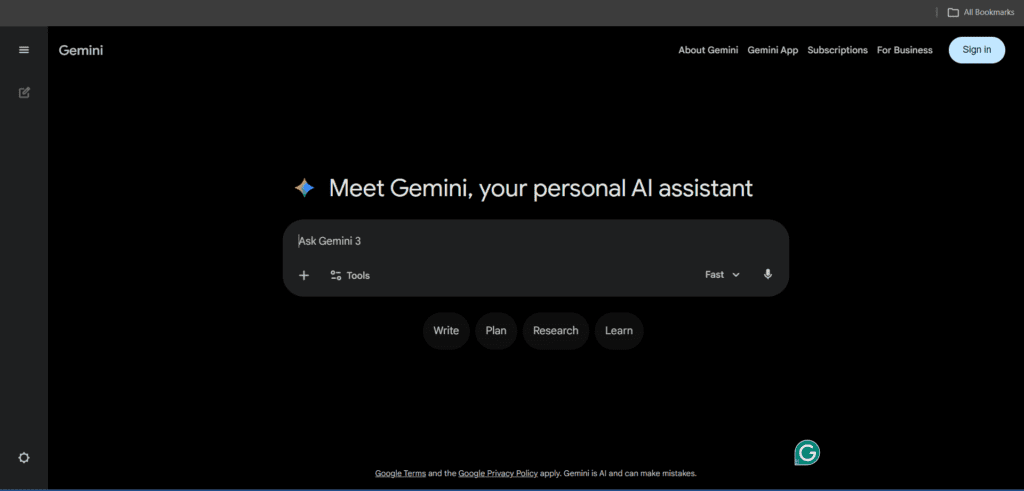
Gemini, developed by Google DeepMind as part of Google, guided by Sundar Pichai, is now a multimodal AI model designed to process and easily produce text, visuals, and code all in one place.
Seamlessly integrated across Google’s ecosystem, it empowers individuals, developers, and businesses by enhancing productivity, sparking creativity, and expanding accessibility.
Strengths:
- Multimodal capabilities (text, images, code).
- Real‑time access to Google data.
Limitations:
- Privacy concerns for sensitive data.
- Some advanced features require payment.
15. Perplexity – Best for Research & AI Search
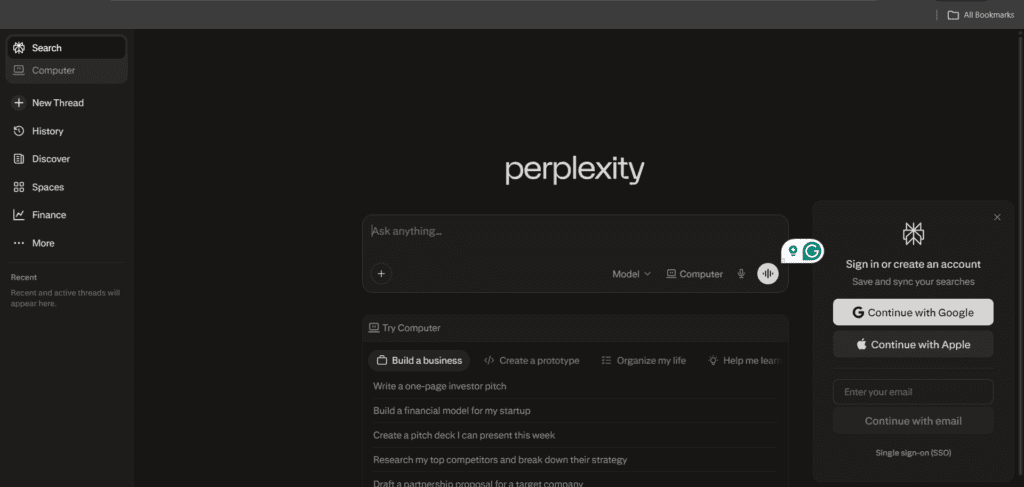
Launched in 2022 by Aravind Srinivas and his team, along with his co‑founders, it has quickly established itself as a leading AI company. Team is an AI search engine that delivers direct, cited answers instead of links.
Designed to make finding information easier, it uses real‑time web data and conversational AI to deliver quick and dependable results.
Strengths:
- Reliable sources with references.
- Great for quick research.
Limitations:
- Limited depth for specialized topics.
- Depends on the internet quality.
Comparison Table of Free AI Writing Tools (2026)
| Tool | Best For | Ease of Use | SEO Support | Content Types Supported | Collaboration Features | Limitations in Free Plan |
| ChatGPT | General writing | ⭐⭐⭐⭐ Easy | Basic keyword suggestions | Blogs, articles, emails, code, social posts | Limited (mainly individual use) | Requires fact-checking; advanced features in paid plan |
| Claude | Long documents | ⭐⭐⭐⭐ Easy | Limited SEO | Summaries, research papers, blogs, technical writing | Good for research teams | Internet access limited; premium features locked |
| Writesonic | SEO blogging | ⭐⭐⭐ User-friendly | Strong SEO tools | Blogs, ads, landing pages, social posts | Team collaboration available | Free plan has usage limits; repetitive text possible |
| Copy.ai | Marketing copy | ⭐⭐⭐⭐ Beginner-friendly | Basic SEO | Ads, product descriptions, emails, social captions | Collaboration tools for teams | Free plan restricted; long-form content needs editing |
| Rytr | Beginner writers | ⭐⭐⭐⭐ Very easy | Limited SEO | Blogs, emails, ads, product descriptions, captions | Basic sharing options | Character limits in free plan; repetitive outputs |
| Grammarly | Editing & grammar | ⭐⭐⭐⭐ Seamless | No SEO | Editing, grammar checks, tone improvement | Works across platforms | Plagiarism checker only in premium; limited languages |
| Notion AI | Productivity | ⭐⭐⭐ Moderate | Limited SEO | Notes, blogs, reports, project docs | Strong team collaboration | Less specialized for writing; advanced features paid |
| QuillBot | Paraphrasing | ⭐⭐⭐⭐ Easy | No SEO | Paraphrasing, summarization, grammar checks | Browser extensions for teams | Word limits in free plan; plagiarism checker premium only |
| Simplified | All-in-one content | ⭐⭐⭐ User-friendly | Basic SEO | Blogs, ads, social posts, images, videos | Team workspace with scheduling | Free plan restricted; performance slows with large projects |
| Scalenut | SEO optimization | ⭐⭐⭐ Moderate | Advanced SEO | Long-form blogs, keyword research, marketing copy | Team collaboration tools | Free plan limited; learning curve for beginners |
| Gemini | Google integration | ⭐⭐⭐⭐ Easy | Basic SEO via Google tools | Blogs, emails, code, images | Seamless with Google Docs/Sheets | Privacy concerns; advanced features paid |
| Perplexity | Research & search | ⭐⭐⭐⭐ Easy | No SEO | Research summaries, explanations, quick answers | Individual use only | Limited depth for specialized topics; depends on web sources |
16. Conclusion
AI writing tools aren’t just nice to have anymore; they’re now a must‑have for writers, essential for modern bloggers. From ChatGPT’s versatility to Scalenut’s SEO focus and Perplexity’s research capabilities, each tool offers unique benefits.
The best part? Most of these platforms provide free plans, making them accessible to anyone. When you add these tools to your workflow, everything becomes faster and easier. You can publish faster, write smarter, and maintain a consistent blogging schedule in 2026.